
Pick up with your layers.
Open supported layers, groups, masks and artboards. Import Affinity documents through an optional bridge. Save an editable .oma working copy, with conversion notes that explain what changed.
Developed for Omarchy BTW.IllustratePaintRefineAnimate
get started in under 1m
curl -fsSL https://raw.githubusercontent.com/michaelmonetized/omadesign/master/scripts/install-remote.sh | shv0.0.4-alpha fixes rotated node editing and adds right-click flip controls. Read the release notes.
Included in v0.0.4-alpha
Copy a look across photos, save presets, and develop a folder in the background. v0.0.4-alpha includes layered interchange and native Linux downloads for ARM64 and x86_64.
Open supported layers, groups, masks and artboards. Import Affinity documents through an optional bridge. Save an editable .oma working copy, with conversion notes that explain what changed.
Develop a RAW photo, copy its adjustments, and apply them to selected photos or a whole folder. Save shareable .omapreset looks and keep each original’s edits in its own .omaphoto file.
Reads your Omarchy colors and desktop font at launch. Uses Catppuccin when an Omarchy theme isn’t available.
Cached rendering. Background previews, file scans, and exports. Built for ARM64 and x86_64 Linux.
Editable documents and portable brand kits on your disk. No app account. Free and open source.
Pick a tool and hold Ctrl, Shift or Alt to see its shortcuts.
Posters, identity, social, and editorial. Nine categories. Preset or custom sizes. All included, all offline.
Template library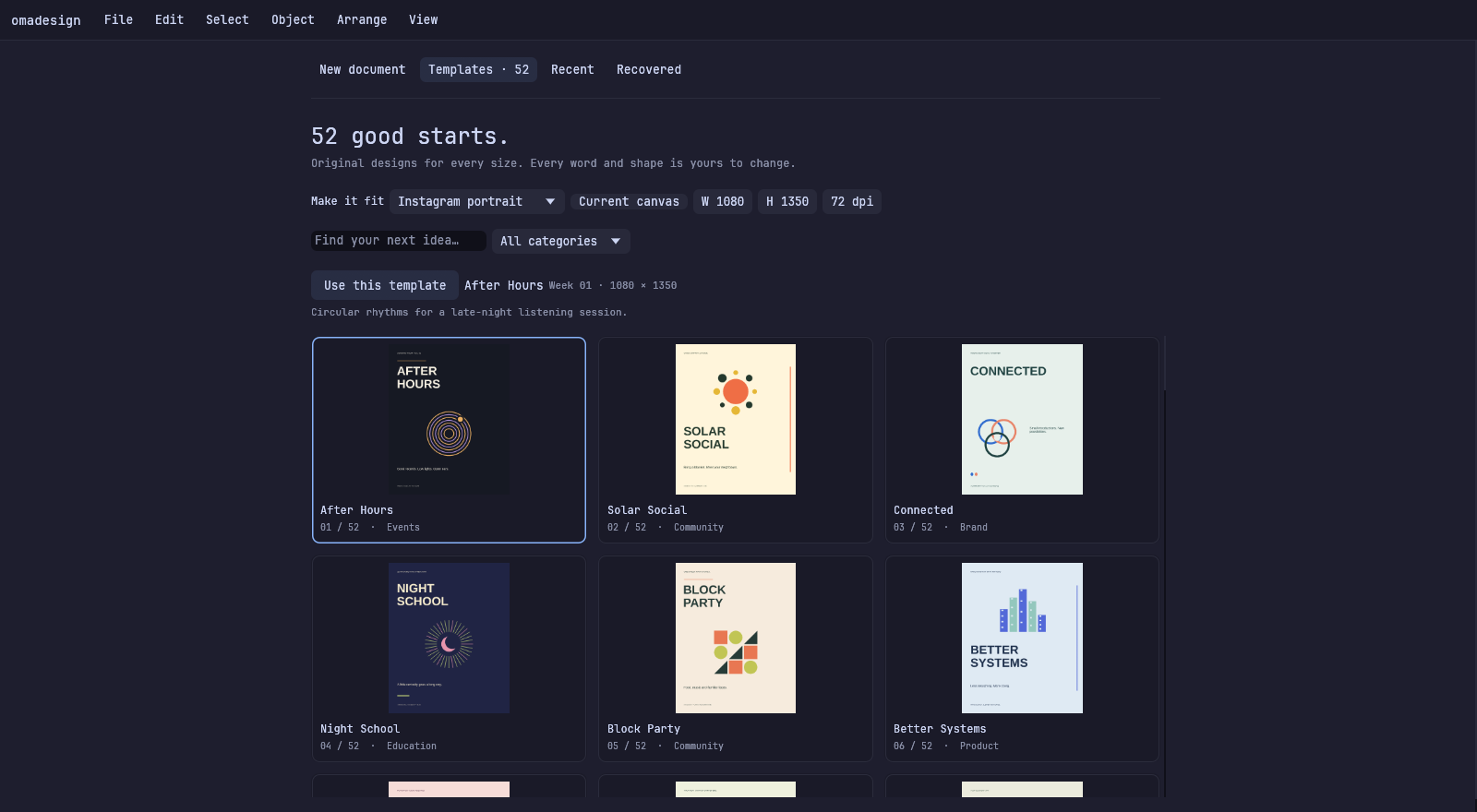
Click corners, drag smooth curves, continue open paths and join endpoints. Close a shape or finish an open line.
Move points, segments and Bézier handles directly on rotated paths. Add or remove nodes, switch corners to curves and break handle symmetry.
Draw rectangles, ellipses, polygons, stars and lines. Adjust corner radius, side count and star proportions.
Sketch editable curves with the Pencil tool, then refine their points with Node.
Move, scale and rotate with canvas handles. Right-click to flip vectors horizontally or vertically. Alt-drag makes a copy; text stays live until you explicitly outline it.
Unite, subtract, intersect, exclude or divide shapes on one layer. Combine and release contours, with holes and Undo preserved.
Turn a stroke into editable filled geometry, including caps, joins and dashes. Keep the original fill underneath.
Convert a pixel layer to vector paths with adjustable threshold, color count and smoothness.
Drag guides from the rulers, move the origin and switch between pixels, millimeters, centimeters, inches and points.
Turn vector artwork into non-printing guides. Edit their contours, snap to their curves and release them back to artwork.
Snap to objects, artboards, guides and the grid. Alignment lines and equal-spacing measurements appear as you move.
Hold Shift for horizontal, vertical or 45° placement. Hold Ctrl to reverse snapping during a drag, and combine Shift with Alt-cloning.
Distort, skew, add perspective or use a nine-handle warp mesh. Editing converts live text and parameter shapes to paths; Undo restores them.
Click to start typing, add line breaks and return to existing text with a double-click. Your source stays editable.
Choose local fonts and adjust size, tracking and leading. Control kerning, ligatures, tabular figures and small caps where the font supports them.
Pick color with HSV or hex, sample artwork, reuse recent colors and drag a gradient across a selected shape.
Find objects with matching fills, strokes or effects, or select those with or without a property. Hidden and locked artwork stays excluded.
Add blur, shadows, outlines through dilation, color adjustments, turbulence and displacement. Effects remain adjustable and carry into SVG.
Combine layers with opacity and 16 blend modes, including Multiply, Screen, Overlay, Difference, Hue and Luminosity.
Paint on pixel layers with adjustable size and hardness. Shift constrains a stroke from its last free point.
Remove pixels, fill connected areas and blend nearby color with dedicated tools and controls for the current task.
Alt-click a source, then paint. Clone copies texture; healing blends sampled texture with the destination’s local color. Undo restores the stroke.
Isolate an area with rectangular or elliptical marquees, a freehand lasso or a tolerance-based magic wand.
Reveal all, hide all or start from a selection. Paint black or white, invert or remove the mask, or apply it to pixels.
Copy one photo’s look, select a range or the whole library, and apply it in one step. Choose which adjustments travel; crop and rotation stay separate by default. Undo restores the batch.
Apply adjustments to a folder in the background without opening every RAW file. Track progress, cancel remaining work, and keep original images untouched.
Name and save a look, filter your preset library, and share it as an .omapreset JSON file. Apply it to another photo or a selected batch.
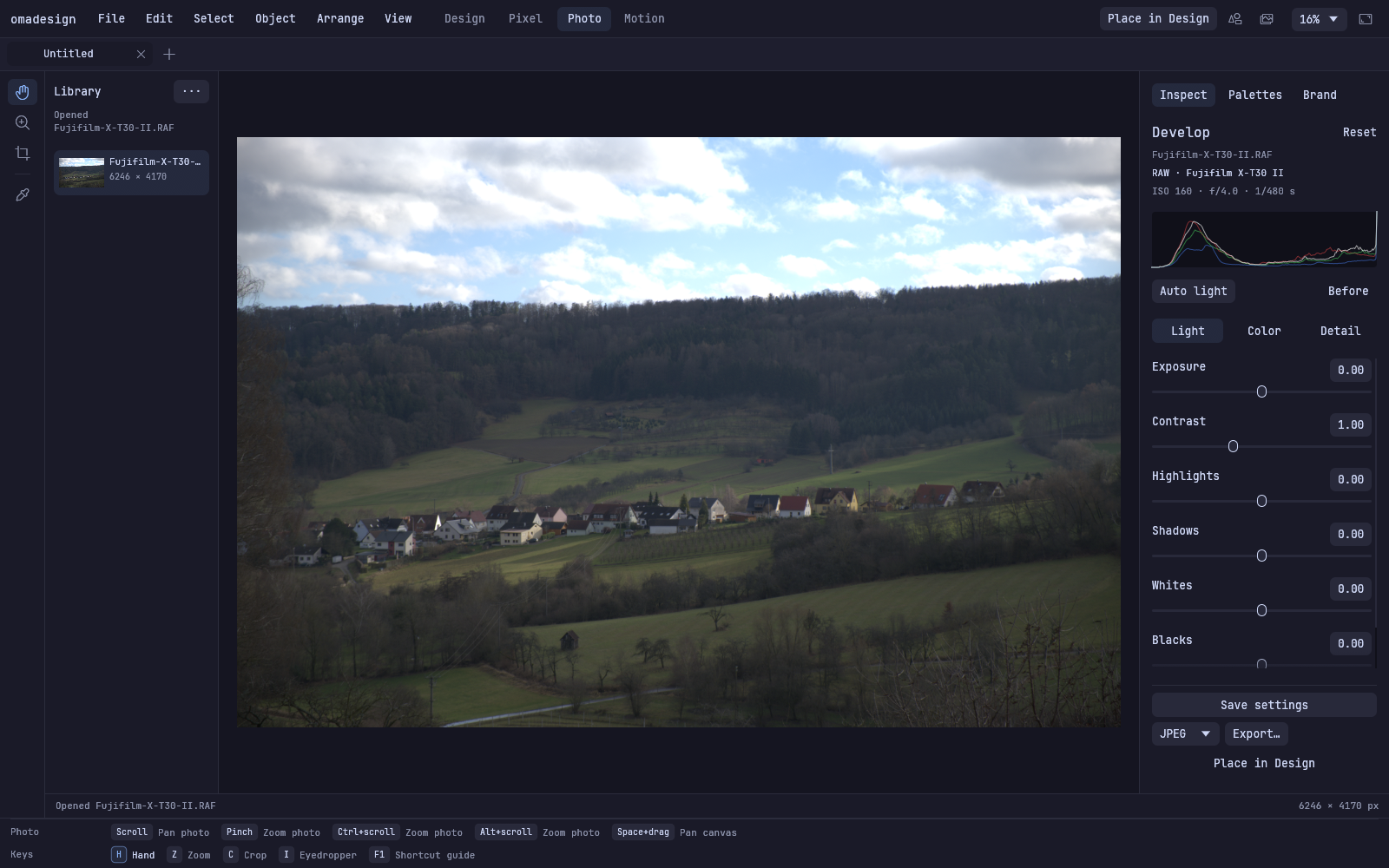
Open a folder, drop images or try the samples. Inspect the histogram and use Before to compare with the original.
Adjust exposure, contrast, highlights, shadows, whites and blacks. Refine the tone curve or start with Auto light.
Set temperature, tint, vibrance and saturation. Explore the HSL mixer, shadow/highlight grading, clarity, dehaze, grain and vignette.
Crop and rotate, inspect at 100%, export a developed JPEG in the background or place the result as a pixel layer in Design.
Open DNG, Canon CR2/CR3, Nikon NEF, Sony ARW, Fujifilm RAF and other supported camera files with the bundled decoder. Develop full-resolution 16-bit linear pixels; camera and compression coverage varies.
Save exposure, color, crop and other settings beside the original in an .omaphoto file. Reopening restores them; Undo and Redo track each photo’s edits. The original stays untouched.
Inspect source detail at 100% while work runs in the background. Export developed RAW photos to 16-bit PNG or TIFF, or 8-bit JPEG. Placement in Design becomes an 8-bit pixel layer.
Animate position, rotation, scale and opacity, plus stroke and fill reveals. The motion clip stays with the native document.
Create keys, drag them to retime, change easing and remove them. Scrub, play and loop the result on the canvas.
Try Draw stroke, Pop in, Slam, Shake, Fill up, four slide directions, Fly, Zoom, Buzz and Fade in.
Set duration, delay, stagger, intensity and the starting playhead position. Presets create ordinary keys you can refine or undo.
Export animated SVG with masks and effects, or Lottie for supported vector animation. Lottie reports unsupported pixels, layer masks and effects.
Search nine categories of editable designs, all available locally. Artwork and copy adapt to portrait, square and landscape proportions.
Start with print, screen, social, identity or photo sizes, or enter your own dimensions and DPI. Templates use the size you choose.
Create, name, duplicate and filter palettes. Collect colors from artwork, add transparent hex values and apply swatches to fill or stroke.
Collect logos, images and native artwork in searchable folders. Background previews and refresh keep the bank in step with files on disk.
Drag a brand tile onto an artboard or double-click to center it. Native assets retain editable artwork and motion, with one Undo per placement.
Add TTF or OTF files, name roles and apply them to live text. Font files travel with the project without a system installation.
Share palettes in .omacolors, font roles in .omatype and artwork plus fonts in .omabrand/. Import or save copies from the sidebar.
Switch between Design, Pixel, Photo and Motion. Keep several documents open and move between them without closing your work.
Expand vector layers to find individual objects. Select, name, hide, lock and reorder artwork from the layer stack.
Draw, name, move, resize, rotate or clone artboards. Wrap a selection in a board and show bleed or safe-area guides.
Copy, cut, paste and duplicate objects. Copy a style separately and apply it to other artwork without replacing its geometry.
The Shortcut HUD follows your tool and held modifiers without moving the canvas. Toggle it with Ctrl+/ or open the full key list with F1.
Omarchy colors and your desktop font shape the interface at launch. Pan with Space, pinch to zoom, or drag a zoom box.
Changed documents recover in the background, including project fonts. Save prompts and library conflict notices help protect unsaved artwork and palette drafts.
Open .oma, SVG, PNG, JPEG, WebP, GIF, BMP and TIFF. SVG uses a supported subset; Lottie has a separate basic shape-animation importer.
Import supported PSD/PSB layers and masks, multi-page PDF and PDF-compatible AI artwork, SVG/SVGZ groups and OpenRaster layers. Photoshop text and smart objects use saved layer pixels. EPS/PS requires Ghostscript.
Import supported .afdesign, .afphoto, .afpub, template and package documents with an optional converter. Compatibility is partial; many effects and publishing features are lost. New unified .af support awaits verification with a real document.
Share supported layer structures and PDF pages, with conversion notes for substitutions or flattened appearances. Keep .oma as the editable working source. Native AI and Affinity writing are not available.
Export still artwork with selectable raster scale. SVG keeps vector geometry and outlines project-font text; .oma retains the editable source.
Browse Google Fonts and icon libraries, or search Pixabay and Pexels with your API keys. Local templates and bundled Phosphor shapes work offline.
See the format guide for import, export and compatibility limits, or the manual for editing workflows.
omadesign is an alpha Linux app. Release downloads are available for x86_64 and ARM64 Linux, with a glibc 2.35 baseline. ARM64 includes Linux on Apple Silicon through Asahi; it is not a macOS build. Omarchy integration is built in, with fallback colors and fonts for other desktops.
Yes. v0.0.4-alpha includes layered interchange, camera RAW development, batch photo adjustments, shareable presets and 16-bit photo export alongside the existing studios, templates and brand tools. Affinity import requires a separate optional bridge setup. The app remains an alpha; the format guide explains compatibility limits.
Import supported .afdesign, .afphoto and .afpub artwork through the optional Affinity bridge. This is partial compatibility: most adjustments, live effects and publishing structures are not retained. The bridge includes new unified .af support, but a real .af document has not yet been verified. Keep your original; native Affinity export is not available.
Core editing, local brand libraries and all 52 templates need no omadesign account or internet connection. Downloading fonts or icons and searching online photos requires a connection. Pixabay and Pexels search also require your own provider API keys.
Copy the .oma document together with .omacolors, .omatype and the complete .omabrand folder. Project fonts stay inside .omabrand/fonts so text remains editable on another machine. Palette and typography edits have their own save controls; save those drafts before sharing the folder.
Advanced publishing and text layout, reusable symbols and collaboration are not available. There is no complete Affinity or Illustrator round trip, PDF/X or CMYK print workflow. RAW camera support varies, and proprietary camera looks and automatic lens corrections are not reproduced. Motion exports to animated SVG or supported Lottie, not MP4 or GIF; Lottie cannot preserve pixel layers, layer masks or effects.
Native Linux support, Omarchy theme integration, portable brand dotfiles, and vector design, painting, photo editing, and animation in one app. omadesign is an independent alpha.